
We absolutely require that any tenants renting units we manage have renters’ insurance. It tends to be a low-friction rule that protects everyone, especially the owner and manager. In this article, we will describe the benefits that renters’ insurance typically covers.
What does renters’ insurance cover?
The biggest things it covers are damage to the unit, the building, or surrounding units caused by the tenant’s actions. The best example is a kitchen fire that causes extensive damage, smoke issues, and all other related problems. We have had this exact thing happen to us: the tenant started a kitchen fire. The renter’s insurance paid us about 18k to repair the damage and for any loss of rent during the restoration. Additionally, recently here in Bend, there was a news article in the Bulletin about a similar incident: $75k in damage, but luckily the renter had insurance.
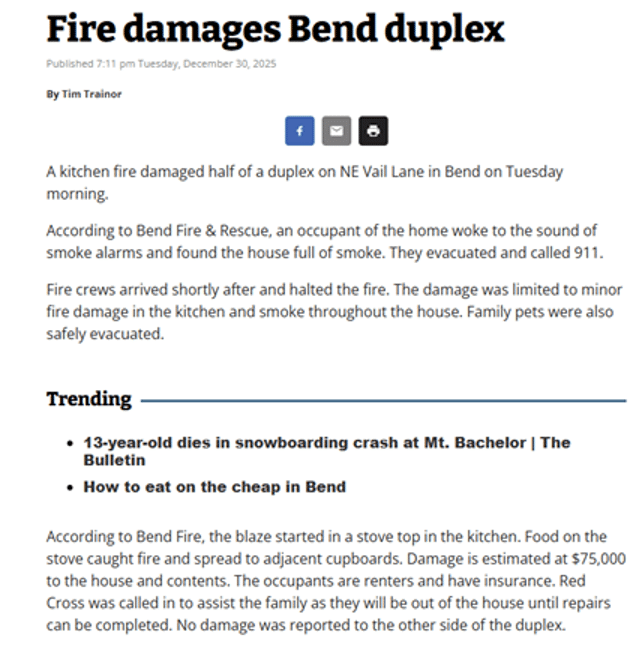
The second big reason is liability coverage, which usually provides at least 100k in coverage. A good example is the tenant’s liability if their pet bites someone or attacks another pet; the renters’ insurance would, in many cases, cover medical costs or liability that comes from that.
Below is a list of other items the renter’s insurance covers:
1. Major Water Damage
2. Renters’ personal items (some policies do not cover this for the renters)
3. Loss of use (relocating tenant to temp housing and loss of rents to the owner)
4. If a guest was injured inside the tenant’s unit
Keep in mind that there may be differences in which specific items are covered by the different carriers’ renters’ policies. We always ask to see their policy documents to understand what their policy covers. Ultimately, the renter’s policy covers a lot.
What are the benefits?
There are a few significant benefits. Number one: you do not have to make a claim to your own insurance. Therefore, you won’t have to pay deductibles or affect your future policy cost because of the hit of the claim. Not to mention the pain of dealing with insurance to get the claim paid out. In our experience working with the renter’s insurance, they paid out quickly, and the process was surprisingly smooth. If the tenant is found at fault, all damages would be covered rather than having to collect from the tenant, since the security deposit would cover only a small fraction. Also, this attracts more responsible tenants and filters out high-risk tenants, since the cost is usually $10-20 per month (renters can usually get the policy from their auto carrier), meaning financially stable tenants should be able to pay that no problem.
Requiring tenants to have renters’ insurance is a no-brainer. It’s just another layer of risk mitigation coverage. A couple of last things to note: you need to track when the renters’ policies are expiring so you can stay in touch with them to renew them. Here at RidgeLine, our property management software tracks this for us so we can always stay on top of it. Also, the renter can name you as an additional insured to ensure you are covered under the policy. Based on our experience and what we see out there, you must always require renters’ insurance, and if a tenant pushes back, don’t rent to them.