
Every rental owner in Bend eventually asks: Is a property manager actually worth what they charge? This article breaks down what a good property manager actually does, and if the cost is worth it; spoiler alert: it really depends on your specific situation.
A property manager handles the day-to-day operation of your rental: finding and keeping good tenants, coordinating repairs, collecting rent, keeping your books straight, and making sure you’re not exposed legally. Below is exactly what that includes, with real examples from properties we manage here in Bend.
If you’d rather see the short version first, our owner services page covers the same list.
Marketing and Leasing Your Rental
Good management starts before anyone signs a lease.
We price the rental based on what’s actually happening in the Bend market right now, not what a listing site’s automated estimate says. From there, we market the unit, field inquiries, run showings, process applications, screen tenants, draw up the lease, and coordinate the move-in.
Screening matters most and shows the least. A vacancy costs you money every day it sits empty, but the wrong tenant costs you a lot more than a slow month of vacancy ever will. We check income, rental history, credit, bank statements, employment verification, background checks, and eviction history on every applicant, every time, no exceptions for someone who seems nice at the showing.
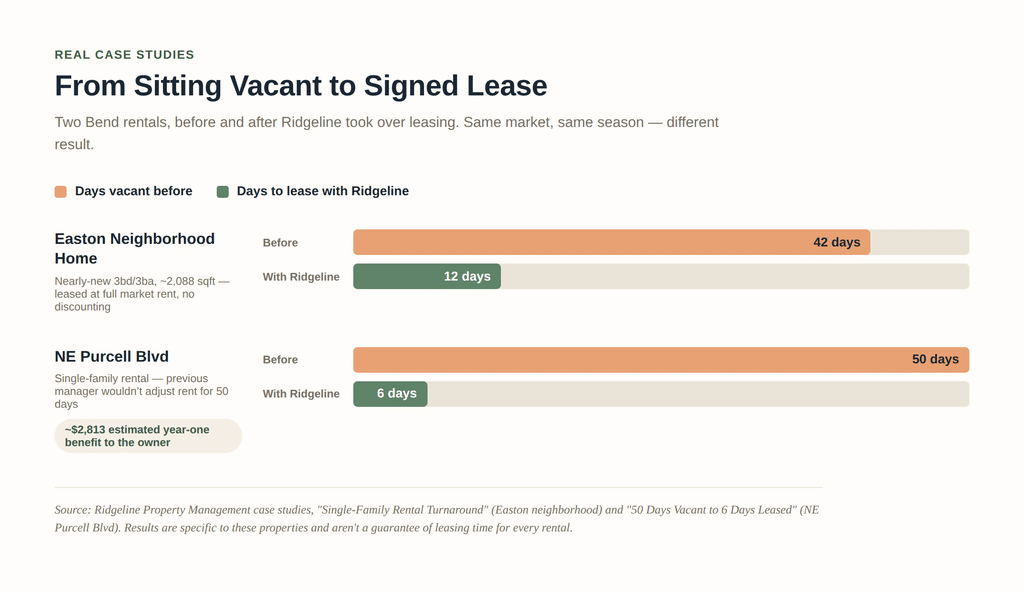
The goal isn’t just to fill the unit fast, though speed matters. It’s to put someone in there who pays on time, takes care of the place, and doesn’t turn into a headache six months in. Two recent examples show what that looks like in practice. A nearly-new home in Bend’s Easton neighborhood sat vacant for 42 days, costing the owner roughly $103 a day, before we re-priced it, updated the listing, and leased it in 12 days at full market rent. Another property on NE Purcell had gone 50 days without a lease under a previous manager. We adjusted the rent structure and leased it in 6 days, netting the owner about $2,813 more over the year than the prior approach was on pace for. That’s why we back our leasing timelines with an actual guarantee instead of just a promise.
Slow leasing is usually a pricing or presentation problem, not bad luck. We wrote more about why a Bend rental sits empty longer than it should in why renters aren’t applying to your rental.
Rent Collection and Lease Enforcement
Collecting rent is simple right up until it isn’t.
We give tenants a consistent way to pay, track every payment, follow up the moment something’s late, and enforce the lease when there’s a problem. None of that is glamorous, but it’s what keeps a rental profitable instead of just occupied.
For owners, the real benefit here is distance. You’re not the one calling your own tenant to ask where the rent is, and you’re not the one deciding on the fly how much slack to cut them this month. It stays consistent because it’s not personal. If you own more than one unit, that consistency matters even more, since rent collection has a way of turning into an unpaid part-time job if you’re doing it yourself across several properties.
Maintenance and Repairs
This is usually where self-managing owners feel the time crunch first.
A tenant reports a leaking sink. Someone has to figure out how urgent it actually is, call the right vendor, get access arranged, sign off on the cost, keep the tenant in the loop, and confirm the work actually got done and done right. One of those a year is manageable. A dozen of those a year, on top of your regular job, adds up fast.
We’re the point of contact for it all: intake, triage, vendor coordination, emergency calls, tenant communication, and a paper trail of what was done and when. Repairs still happen; that’s just part of owning a rental, but they stop being your problem to solve every time.
Inspections and Property Condition
Owning a rental isn’t just about collecting rent. It’s about protecting what you own.
We document the property’s condition at move-in and move-out, and we check in periodically in between. That periodic check is often what catches a slow leak, a deferred maintenance issue, or something a tenant changed without asking, while it’s still cheap to fix. It also gives you real documentation if there’s ever a dispute over a security deposit.
Inspections are exactly the kind of task a busy owner keeps meaning to get to and never quite does. Making them a normal, scheduled part of property management is one of the simplest ways to avoid an expensive surprise later.
Oregon Landlord-Tenant Compliance
Oregon has a long list of rules governing the landlord-tenant relationship: security deposits, notice periods, rent increases, entry rules, screening practices, how a termination has to be handled, what has to be documented and when. And those rules shift more often than most owners realize.
We stay current on what applies and build our processes around it, so you’re not the one finding out about a change in the law after it’s already cost you a fine or a lost eviction case. That doesn’t erase every bit of legal risk that comes with owning rental property, but it closes off the mistakes that happen simply because nobody was watching for a rule change.
This is also where self-managing owners tend to get caught out. We covered the specific rules that separate a compliant DIY landlord from one headed for trouble in the 5 Oregon laws that separate DIY landlords from pros.
Financial Reporting and Recordkeeping
You shouldn’t have to piece together your rental’s performance from bank statements and a shoebox of receipts every spring.
We give owners clear, regular reporting on rent collected, management fees, maintenance costs, vendor invoices, security deposits, and anything else moving through the property. It’s the difference between guessing how your investment is doing and actually knowing, and it makes tax time considerably less painful. For owners with more than one property, that consistency lets you compare properties instead of managing each one in isolation.
Lease Renewals and Tenant Turnover
A lot of what a rental actually costs you shows up in the gap between tenants.
As a lease nears its end, someone has to check whether the rent still matches the market, talk to the tenant, prepare the renewal paperwork, provide any required notices, and decide whether anything needs to change.
If the tenant’s moving out instead, that list gets a lot longer: inspection, cleaning, repairs, paint, yard work, vendor scheduling, pricing, marketing, showings, screening, and a new move-in, ideally all handled without a month of vacancy in between. We also pre-lease to fill the unit before the current tenant leaves, reducing vacancy time.
The turnarounds we mentioned earlier, 12 days and 6 days on properties that had each sat vacant for six to seven weeks before we took them on, are the kind of result this part of the job is built for. Handled well, turnover is fast and mostly invisible to you. Handled poorly, it’s the single biggest drag on what a rental actually earns you in a year.
What Does This Look Like for Larger Properties?
The fundamentals hold whether you own a single-family rental, a duplex, or an apartment building. What changes is the scale.
With a multifamily property, there are more leases, more move-outs, more maintenance requests, and more tenant conversations happening at once, plus things a single-family owner doesn’t usually deal with at all: common-area upkeep, shared utilities, parking, landscaping contracts, tenant disputes, and several units needing attention in the same week.
We’ve managed that scale firsthand. Our multifamily and apartment complex management work currently spans properties up to to 100 units, including a full renovation and lease-up of a 12-unit building here in Bend and, more recently, a 14-unit property. The job itself doesn’t change: keep the property full, respond to tenants, protect the asset, manage the budget, and give the owner a clear view of what’s happening. What changes is that a real system matters even more once you’re coordinating dozens of units instead of one.
For owners of apartment complexes and multifamily buildings, professional management isn’t just about fewer maintenance calls. It’s about running the property like the investment it is, instead of a collection of individual fires.
What Does a Property Manager Actually Take Off Your Plate?
Owners comparing self-management to hiring it out tend to focus on the monthly management fee. A more useful comparison is everything you’re currently doing yourself.
Without a property manager, you’re the leasing agent, the rent collector, the maintenance coordinator, the bookkeeper, the tenant’s first call, the inspector, and the person responsible for keeping up with Oregon’s rental laws. Some owners like wearing all those hats. Plenty of others bought a rental property because they wanted to own “passive” real estate, not because they wanted a second job managing it.
That’s the real value of hiring a property manager: it gives you a team to handle the operational work so you can stay the owner making the decisions that matter, instead of the one fielding every call.
Is Hiring a Property Manager Worth It?
There’s no single answer that fits every owner.
If you own one property, live close by, like dealing directly with tenants, and have the time to stay on top of maintenance and Oregon’s rental rules, you can manage it yourself. But if vacancies drag on, maintenance calls interrupt your evenings or weekends, you own more than a unit or two, or you’re not entirely sure you’re handling something correctly, that’s usually a sign it’s time to hand it off.
The real question isn’t whether you can manage the property yourself. It’s whether that’s still the best use of your time, and the best way to run the investment.
If you’re weighing that decision for your Bend rental, we’re happy to walk through the property, your goals, and what management would actually look like for your situation. No pressure, just a straight answer.
If you are comparing specific companies, our side-by-side look at Bend property managers shows who each one is best suited for. If you are still deciding what to look for, start with how to choose a property manager in Bend.
Talk With Ridgeline Property Management About Your Bend Rental